Printed Concert Programmes or Spoken Welcomes: Giving Listeners Context Without Distraction
Printed concert programmes or spoken welcomes can add useful context without stealing attention. Choose what listeners need, and when they need it.
The common mistake with a printed concert programme or spoken welcome is to treat them as rival ways to explain the evening. The cost is either a leaflet that competes with the music or a welcome that turns a short pause into a small lecture. Each can give listeners context; the useful question is what they need to know, and when.
At a village hall concert, that timing is unusually visible. Someone may still be finding a seat, greeting a neighbor, or folding a coat when the first notes begin. A printed programme can wait patiently. A spoken introduction gathers everyone at once, including the people who were hoping to settle in quietly. Neither choice is automatically more considerate.
Context and attention
Context helps a listener notice something in the music: a change of mood, an unusual instrument, or a connection between two pieces. It is not a set of instructions for how to feel. An introduction that tells people what to listen for can open a door; one that explains every turn can leave them with little to discover.
The two formats work on different schedules. A programme lets people choose when to read and how much to take in. A spoken welcome reaches the room together, but only at the moment it is given. That difference matters in a rural venue, where a concert may have no printed house notes, no large display, and no convenient way to catch a sentence that was missed.
Think of context as a small handrail, not a route map. A listener might benefit from knowing that a set pairs a traditional tune with a new response to it. They probably do not need a paragraph explaining each musical decision before hearing either piece.
What print can hold
A printed programme is useful for information that listeners may want to revisit. It can list the order of works, name performers and instruments, give the composer’s name, and briefly explain an unfamiliar term. It also serves people who prefer to read at their own pace or who do not catch spoken announcements clearly.
Its weakness is not simply that paper rustles. A dense leaflet asks for attention during the very minutes when the music is asking for it too. Small type, long biographies, and notes that describe each passage can turn the audience into a roomful of people looking down. The programme should offer a choice, not set a reading assignment.
A compact layout helps. Put the running order and essential names where they are easy to find. Keep longer context in a short note that can be read before the performance or during an interval. If the programme is folded, make the first visible panel useful on its own; a reader should not have to unfold an origami project to discover who is playing.
Print also has practical limits. A venue may not have a printer, volunteers may be managing the door and chairs, or the final running order may change. A simple sheet produced on an ordinary office printer is often more useful than an elaborate booklet whose preparation becomes the evening’s main production.
What speech can do
A spoken welcome is strongest when the information is brief, timely, and difficult to convey through a sheet alone. It can tell people where the interval will fall, acknowledge a local host, explain an unexpected change, or give a single piece of context that helps the first work make sense. The speaker can also set a relaxed tone without asking the audience to read anything.
Speech is temporary. A person arriving late may miss it; a person who finds spoken information difficult to follow cannot scan it again. A long welcome can also delay the music and make listeners feel they must remember names and details before the first piece begins. Keep operational announcements separate from commentary about the programme, and say only what the room needs at that moment.
Good delivery is plain rather than grand. Use a microphone if the room needs one, speak toward the audience, and leave a beat before the music starts. There is no need to describe the evening as historic, intimate, or unforgettable. The chairs and the music can manage their own publicity.
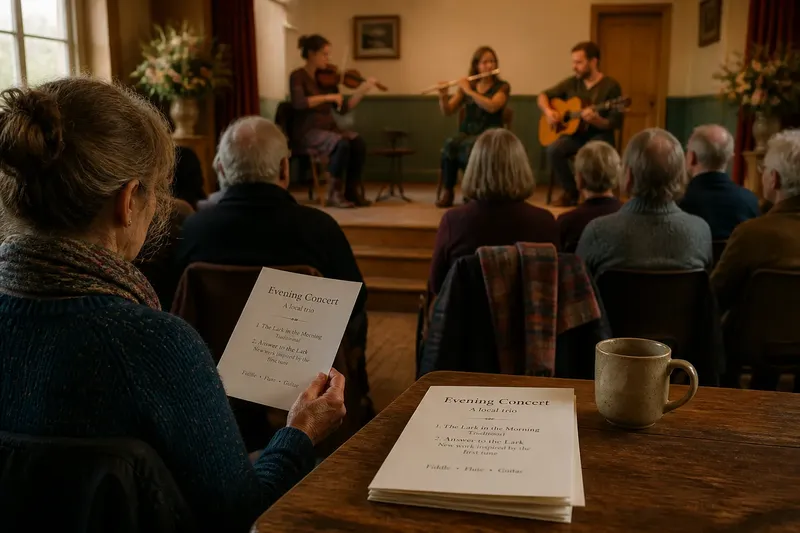
Say you are organizing a fictional concert in a village hall, with a local trio playing a familiar folk melody followed by a new piece inspired by it. A one-page programme could list the pieces and performers, while a brief welcome explains that the second work answers the first. Listeners can then read the names before the concert and hear the connection without being told what emotion to expect.
Choosing the right balance
Start with the audience’s likely question. Is the order of the music unclear? Put it in print. Is there one connection that makes the opening pair more rewarding? Say it briefly. Has the venue changed the interval arrangement? Announce it aloud, then include it on the sheet if people may need to check later.
For many small concerts, a light combination works well: a clear programme for names and sequence, plus a spoken welcome for one useful point and essential logistics. This does not mean both formats must contain the same information. Repeating every note aloud wastes the audience’s attention and the speaker’s breath.
Before preparing either, ask:
- What must listeners know before the first piece? Keep that information short and place it where it can be found in time.
- What may they want to check later? Print names, titles, order, and any useful interval detail.
- What benefits from being heard together? Reserve speech for a brief connection or a change that affects everyone.
- What can be left unexplained? A work does not need a note for every mood, image, or formal turn.
- Who might miss one format? Consider legible print, clear speech, and a simple way to catch essential information.
The answers may point to print alone, speech alone, or both. A short recital with familiar works may need little introduction. A mixed programme with unfamiliar titles may benefit from a sheet that gives listeners something to return to. A last-minute change may call for a spoken note, even if the printed copies are already on the chairs.
When should context arrive?
Should notes explain every piece?
No. Include context when it clarifies a meaningful connection or an unfamiliar feature, rather than filling space beside every title. A listener can meet some music without a guide standing between them and it.
Is a spoken welcome better for late arrivals?
Not usually, because late arrivals may miss it. Put lasting details in the programme or make them easy to ask about discreetly, and keep the welcome focused on information the room needs together.
How long should an introduction be?
Long enough to make one useful point and deliver any essential announcement. If it needs several paragraphs, the extra context is probably better in print or can be left for conversation after the performance.
What if there is no printed programme?
A short welcome can name the performers, outline the order, and mention one helpful connection. If the details are likely to matter later, a notice by the entrance or a simple digital copy can give people another way to check them.
Keeping attention intact
The test is not whether listeners receive the most information. It is whether the information arrives without making attention feel like a duty. A programme can remain closed during the music. A welcome can end before the first note. Those are small courtesies, but small concerts are made of such things: a clear chair, a quiet pause, and enough room for the music to speak in its own time.
For a printed concert programme or spoken welcome, choose the format that fits the information rather than the one that looks more formal. Put reusable details on paper, speak only what benefits from being shared in the room, and leave listeners free to decide how much context they want to carry into the music.